“Colossus Failure”: Elon Musk’s Data Centers Face Lawsuit for Polluting Black Neighborhoods in Memphis
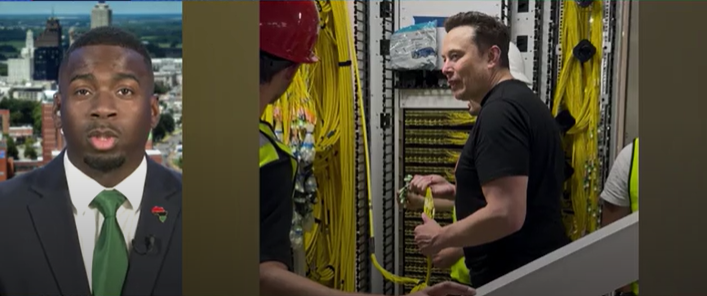
As tech companies scramble to build massive new data centers to power artificial intelligence, marginalized communities are bearing the brunt of the environmental harms. In Memphis, Tennessee, Elon Musk’s xAI operates over two dozen methane gas-burning turbines without legal permits to power its data centers, Colossus 1 and Colossus 2, polluting the nation’s largest majority-Black city with toxic emissions. The NAACP is suing xAI for violating the Clean Air Act. “We are, unfortunately, a cautionary tale about what will and possibly can happen if you don’t have the right rules and guardrails in place,” says KeShaun Pearson, the executive director of Memphis Community Against Pollution. Pearson says pollution from xAI’s energy generation is already “at a level even higher than our Memphis International Airport.” Meanwhile, the company has created far fewer jobs than it initially promised.
Transcript
This is a rush transcript. Copy may not be in its final form.
AMY GOODMAN: On this Earth Day, we’re continuing our look at community resistance to the construction of AI data centers. Last week, the NAACP sued Elon Musk’s xAI, accusing the artificial intelligence company of polluting Black neighborhoods with toxic emissions from its makeshift power plant fueling its data centers in Memphis. The lawsuit alleges xAI is violating the Clean Air Act by operating over two dozen methane gas-burning turbines without legal permits.
KESHAUN PEARSON: We are, unfortunately, in an even worse position than we were a year ago. At this point, we now have two facilities, Colossus I and Colossus II, that are being powered by illegal and unlawful methane gas turbines. These turbines generate enough power to power over half a million homes. This is unprecedented, the amount of pollution that we’re being exposed to, nitrogen dioxide, formaldehyde, chemicals that we know cause cancer.
KESHAUN PEARSON: What Elon Musk said is basically smoke and mirrors. Southwest Memphis continues to be targeted. Memphis Community Against Pollution has stood up against multiple corporations and billion-dollar organizations who have sought to see our community as the path of least resistance. These projects specifically focus on a neighborhood, on a community and on a region where you see an increased poverty level and you also see an increased amount of Black families. Just like all over the South, you see a concentration of AI data centers in communities that are largely Black or marginalized. This is nothing new.
KESHAUN PEARSON: xAI has not promoted or really led to the jobs that they said they would. They have not been in communication with the community in any significant way. But what they have done is continue to pollute our air, to do it unlawfully and illegally. We are in a place now where we are literally worse off than we have ever been. Our children have the highest rate of ER visits for respiratory illnesses and issues in the state of Tennessee. And it’s only going to continue to get worse.
KESHAUN PEARSON: In 1968, Dr. Martin Luther King came, and he marched with sanitation workers in the city of Memphis. That was fighting for environmental justice, and that is the fight that we are continuing. Our families are suffering. Our region is suffering. We can’t continue to fall for smoke and mirrors. We have to do something that protects us, and we have to do it now.
Read the full transcript or watch the full show at Democracy Now
Amy Goodman interviews KeShaun Pearson, recorded April 22, 2026
Author Profile

Latest entries
 Labor Rights08/24/2026Socialists’ Winning Streak Is an Opportunity for Unions
 Political Elections08/21/2026Abdul El-Sayed Beats the Democratic Establishment and AIPAC in Michigan
 Democratic Socialism08/14/2026No, AOC: “Woke” Wasn’t “Crazy” the Way You Say It Was
 Political Elections08/13/2026The Socialist Electoral Project Still Hasn’t Hit Its Ceiling