
Will the World Cup Fuel Arrests of Homeless People in Atlanta?
As World Cup matches begin, advocates warn that Atlanta is on track to repeat the arrests, displacement, and criminalization of homeless residents that drew criticism during the city’s 1996 Olympics.
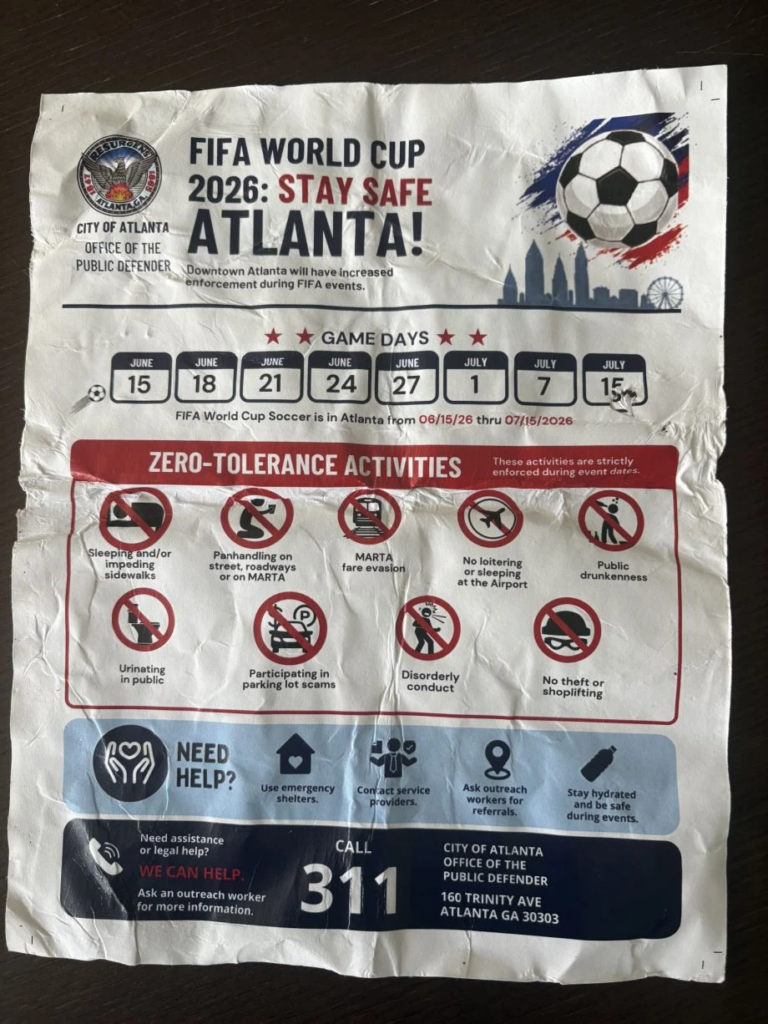
Atlanta promises a welcoming World Cup for everyone. But just days before kickoff, homeless advocates worry the city lacks the safety net needed to keep unhoused residents from being displaced or jailed amid the influx of hundreds of thousands of visitors.
The concern is not just that Atlanta lacks enough units to house everyone. (That’s typical of a major city grappling with mounting homelessness.) The greater fear is that Atlanta’s alternatives to arrest — outreach, shelter access, and pre-arrest diversion — are so strained that the city cannot absorb the pressures of a global event. If tourists or downtown businesses respond to visible homelessness by calling the police, activists warn, Atlanta could return to the strategies employed in 1996.
Back then, in the lead-up to the Olympic Games, Atlanta built a jail. In the 18 months before the festivities, thousands of poor people were arrested on minor charges, many of them unhoused. Others received one-way bus tickets out of town. Allen Hall, who was homeless during the Olympics, summed it up in an interview with Atlanta Civic Circle: “The jails became homeless shelters.”
With housing scarce and supportive services stretched thin before the World Cup, advocates worry that the more than 3,000 Atlantans without stable housing could face a police crackdown, even if city leaders never explicitly order one.
The city has repeatedly vowed not to further criminalize poverty to polish downtown and its environs for well-to-do visitors who might be unaccustomed to unsheltered people. But choosing not to criminalize homelessness requires political will, coordination, and resources. Advocates say Atlanta is short on all three.
Choosing not to criminalize homelessness requires political will, coordination, and resources. Advocates say Atlanta is short on all three.
Last June, Mayor Andre Dickens pledged to “make sure those unsheltered individuals don’t come anywhere downtown, and throughout the city of Atlanta.” He added, “If you break the law, we have measures to deal with that like any other lawbreaker.”
To advocates for unhoused people, that framing leaves an eye-popping amount of room for police enforcement against people whose homelessness already makes them more likely to be cited or arrested for conduct that housed people rarely have to consider: sleeping outside, sitting too long in a public place, walking in the road, trespassing, and urinating outdoors when bathrooms are unavailable.
“Atlanta has gone out of its way to focus so much on our World Cup guests that [the city is] willing to do that to the detriment of our neighbors experiencing homelessness,” says Tiffany Roberts, the public policy director for the Southern Center for Human Rights (SCHR). “It’s a lot like what happened before the Olympics.”
To its credit, the city recently completed an unprecedented “rapid housing” program, creating 500 apartments for unhoused people in about two years. It now has almost 2,400 permanent housing units citywide and nearly 2,800 shelter beds, according to Cathryn Vassell, CEO of Partners for HOME, the lead agency in Atlanta’s Continuum of Care network.
But capacity is not the same as availability. Most permanent housing units are already occupied. Shelter beds may be full; restricted by household type or eligibility; or unusable for people who cannot safely stay in congregate settings, have pets or partners, or fear losing their belongings. And the latest federally mandated Point-in-Time headcount of Atlanta’s homeless population — which found 3,060 people unhoused citywide, over a third of whom were unsheltered — is widely considered a vast undercount.
That leaves overlapping problems: Atlanta does not have enough permanent housing to end homelessness for everyone, and even its temporary options may not be sufficient — or accessible enough—for the unsheltered people most likely to encounter residents, tourists, and police during the World Cup.
“Common sense will tell you that those people, if they’re not going to be here, are either going to be bussed out of the city to other cities in the South or be arrested and put in jail,” says Matthew Nursey, organizing director with Housing Justice League. “We know this because Atlanta [and Fulton County] did exactly that during the 1996 Olympics.”
That frustration is compounded by the ongoing encampment removal operations conducted across the city over the last year. Between May 2025 and May 2026, the city and its homeless services partners relocated 490 unsheltered people from more than 30 locations in and around downtown into housing, says Annie Hyrila, Partners for HOME’s chief program officer. The number of people who did not ultimately receive housing assistance, however, is unknown, reflected only in Atlanta’s latest Point-in-Time Count.
Atlanta’s Old Wheat Street encampment became a flashpoint in the homelessness debate after a clearing operation left an unhoused man dead. (Photo by Sean Keenan)
To read the full article, go to nextcity.org
By Sean-Keenan On June 12, 2026
Author Profile

Latest entries
 War09/16/2026“No good options: Trump insiders reveal crisis that ‘thwarted’ the GOP”, Nick Hilden, AlterNet.
 Labor Rights08/24/2026Socialists’ Winning Streak Is an Opportunity for Unions
 Political Elections08/21/2026Abdul El-Sayed Beats the Democratic Establishment and AIPAC in Michigan
 Democratic Socialism08/14/2026No, AOC: “Woke” Wasn’t “Crazy” the Way You Say It Was