Why many Black Americans were rooting for Argentina to lose the World Cup
Many Black Americans were not cheering Spain’s complicated history. They were rooting against the racism, politics and silence associated with Argentina
There are moments in sports when you realize people aren’t just watching the score any more. They’re watching values. They’re watching who speaks. They’re watching who stays silent. And they’re watching what those silences say.
I found myself thinking about that throughout this World Cup. On paper, Sunday’s final looked simple. Spain v Argentina. Two footballing giants and countries with glorious soccer histories. Two nations whose pasts are also stained by colonization, oppression and chapters of history that shouldn’t be whitewashed simply because someone can score a goal.
So no, this wasn’t some fairytale of good versus evil. Spain’s colonial legacy is well documented. Nobody who knows history should pretend otherwise.
Yet for many Black Americans, this final wasn’t really about rooting for Spain. It was about rooting against Argentina.
When your fanbase repeatedly becomes associated with racist incidents … when videos circulate of Argentinian fans decked out in Argentina team gear hurling racial epithets toward Black people … when the world watched members of Argentina’s national team sing a racist chant targeting France’s Black players after winning Copa América … when American streamer IShowSpeed was verbally assaulted by fans fully dressed in Argentina team gear … when word spreads across social media that in Argentina, there is a real hamburger business in Llavallol whose official name uses the “-a” version of the N-word: “Big N– Burgers” … when Argentina president Javier Milei openly embraces positions that align very closely with Donald Trump and offers support for Israel in the midst of a genocide, ethnic cleansing and slaughter of Palestinians … when Benjamin Netanyahu is asked on a recent podcast if he was rooting for Messi and says, “No, before Messi, Milei. He’s a superstar” … eventually, the tide of supports shifts. After a while, any accomplishments on the field become overshadowed.
It’s like a college basketball coach who has all the appearances of a great program. He has a great winning percentage and a high graduation rate, and all of his players are disciplined, articulate and present themselves as professionals. But you keep hearing stories of verbal abuse and berating, whispers of a tyrant coach who is actively damaging his players’ mental health. At some point, the results become secondary and people start asking, “What’s going on with the Indiana Hoosiers?”
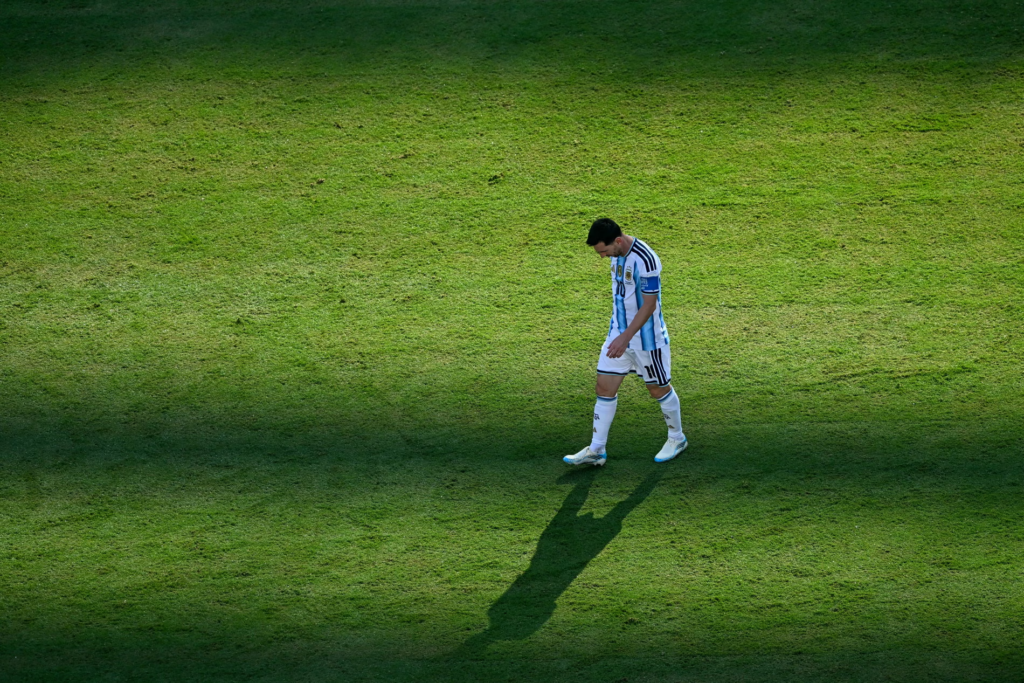
Argentina kept giving people reasons to ask that question. Which brings us to Lionel Messi.
This is where people get uncomfortable because everybody loves Messi, and for good reason. His brilliance doesn’t require exaggeration. His résumé speaks louder than any sports debate ever could. Whether you think he’s the greatest player ever or merely one of them – shoutout to Pelé – you’re arguing over different shades of greatness.
But greatness on the field has never automatically translated into courage off it.
Muhammad Ali taught us that. Bill Russell taught us that. Mahmoud Abdul-Rauf taught us that. Craig Hodges taught us that. John Carlos and Tommie Smith taught us that. Being extraordinary with a ball, a bat or track shoes isn’t the same thing as being willing to risk comfort for conviction.
To my knowledge, throughout this entire World Cup, Messi never publicly condemned the racist incidents involving sections of Argentina’s fanbase. He did not publicly address the racist chant that drew worldwide criticism after Copa América. Nor has he publicly spoken out after videos of Argentina supporters racially abusing Black people circulated online.
He didn’t even offer the kind of broad, indirect condemnation that many critics argued was insufficient when Caitlin Clark addressed racist abuse coming from some of her supporters. As my co-host Chuck Modi argued on our show The Collision: Where Sports and Politics Collide:
“She has to be more specific. When Alyssa Thomas was getting death threats, she has to say Alyssa Thomas by name, and say directly to her fans that you cannot have death threats going to Alyssa Thomas in my name the same way we as Jewish people say not in my name for Palestinian rights. She needs to use all of her clout and tell her fans this is unacceptable.”
Messi did not even clear that lower bar. He offered no public statement at all addressing the racism carried out by some of his supporters.
As Dr Martin Luther King Jr said in his Beyond Vietnam speech: “A time comes when silence is betrayal.”
Sometimes silence becomes its own statement simply because the loudest voice in the room chose not to use it. Contrast that with the generation coming after Messi.
Lamine Yamal has spoken openly about his family’s sacrifices. He has recalled how his father searched through discarded items that could be repaired or sold so there would be enough money for food. He has said he grew up in a tiny apartment where the kitchen and bedroom were one and the same. Today, he says what makes him happiest is seeing his mother smile and knowing his younger brother can enjoy the childhood he never had.
Nico Williams carries a similarly powerful story. His mother, María, walked nearly 2,000 miles while pregnant, from Ghana toward Spain, in search of a better life. Decades later, her son set up the goal that won Spain the World Cup and then placed his winner’s medal around her neck.
Spain’s triumph was never just about tactics, possession or technical excellence. It was about possibility. It was a team that reflected the modern Spain – diverse, confident and shaped by the journeys of families who crossed borders in pursuit of a better life. That, more than any passing sequence or tactical innovation, was their most powerful statement.
After Spain defeated Argentina on Sunday, one image stood out to me: Lamine Yamal embracing Messi. No taunting or chest-pounding or disrespect, just respect from one generation to another. Like the old African Proverb says: “The lion doesn’t need to roar after every meal.”
Another image that resonated was seeing Lamine Yamal kneel in prayer amid the chaos around him while emotions boiled over after the match. While others argued, he prayed. That image reminded me that composure can be louder than confrontation.
To read the full article, go to The Guardian
By Etan Thomas On July 22, 2026