
“America, U.S.A.”: Eddie Glaude on the 250th Anniv., Race & “The Madness at the Heart of the Country”
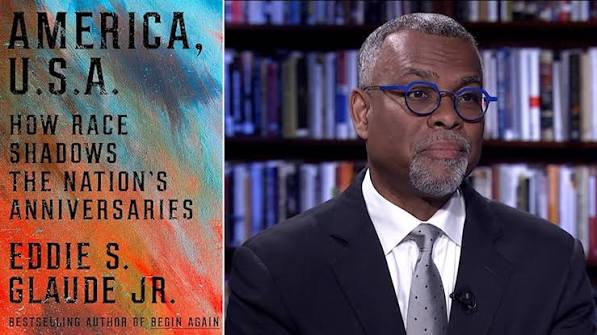
“I do not love America, and never have, especially now.” Those are the opening words of America, U.S.A.: How Race Shadows the Nation’s Anniversaries, a new book from Princeton historian Eddie Glaude. Released ahead of the 250th anniversary of the Declaration of Independence on July 4, the book is a critical look back at how the United States has celebrated previous milestone birthdays, including what narratives were left out of the official commemorations. This comes as President Donald Trump has made himself the center of many events and celebrations for the 250th anniversary, while promoting a “storybook version” of U.S. history that elides the injustice that was baked into the very founding of the country, Glaude tells Democracy Now! in a wide-ranging conversation about race, inequality and the legacy of slavery.
“Donald Trump and his supporters, they want to be white without judgment,” says Glaude. “History is a battleground, because history, of course, holds them to account.”
Transcript
This is a rush transcript. Copy may not be in its final form.
AMY GOODMAN: This is Democracy Now!, democracynow.org, The War and Peace Report. I’m Amy Goodman.
This week, as the United States is getting ready to celebrate its 250th anniversary, we begin our series on reckoning with the dark legacies of this country’s history with a new book by the public intellectual, Princeton University African American studies professor Eddie Glaude Jr. The book is called America, U.S.A.: How Race Shadows the Nation’s Anniversaries, a blistering look at the stories we tell ourselves about our past and present, the book centered around the major celebrations of the United States’ milestone birthdays, from 1876, 1926, 1976, now the 250th in 2026, and in each time, an enduring refusal to face its true history. Eddie Glaude is professor of African American studies at Princeton University. His previous books include Begin Again: James Baldwin’s America and Its Urgent Lessons for Our Own and Democracy in Black: How Race Still Enslaves the American Soul. Professor Glaude’s latest book, America, U.S.A.: How Race Shadows the Nation’s Anniversaries, opens with the words, “I do not love America, and never have, especially now.”
Professor Glaude, welcome to Democracy Now! It’s great to have you with us.
EDDIE GLAUDE JR.: It’s such a pleasure to be back and to see you.
AMY GOODMAN: So, start with those words.
EDDIE GLAUDE JR.: Yeah.
AMY GOODMAN: Talk about why you opened your book in that way.
EDDIE GLAUDE JR.: Yeah, you know, I was — it was an initial moment of fear and trepidation, and I had to say it. I wanted to announce that I have no interest in the idolatry of the state, that I’m more interested in loves closer to the ground, ordinary people. But I also had to foreground the wound, my own interior experience.
You know, as a growing — my dad was the second African American hired at the post office in Pascagoula, Mississippi, and he moved his family in Moss Point from one side of town to the other. And I’m playing — I’ve told this story in Democracy in Black. I’m playing with my Tonka truck, and with my new friend, and his dad came out and said, “Stop playing with that N-word.” And at that moment, America told me what it thought about me. And then I took my truck and went inside, and my parents went to work to keep me from believing what the world said about me.
AMY GOODMAN: How did they do that?
EDDIE GLAUDE JR.: Oh, they put a crown above my head, you know. They told me that, you know, I come out of a grand tradition, that my life was my own to create, that it’s something wrong with them, in a way. And that was affirmed when I went to Morehouse and the like. So, I’m always puzzled when people think I should love the country. They expect gratitude, when I’m more interested in loving the people who make the country what it is.
AMY GOODMAN: So, let’s talk first about the title.
EDDIE GLAUDE JR.: Yeah.
AMY GOODMAN: America, U.S.A.: How Race Shadows the Nation’s Anniversaries. Why America, U.S.A.?
EDDIE GLAUDE JR.: Well, you know, I’m a professor. I have all these folks coming — you know, I read all the time, and I’m — you know, you and I were talking about John Dos Passos. Is it Dos Passos or Dos Passos? And, you know, his trilogy, his classic trilogy, U.S.A., where he looks at the 42nd Parallel and 1919 and big money, is supposed to be this epic account of the country, and it fails when it comes to the issue of race during that period.
But also I’m trying to think about the division, the divided soul of the country, the comma instead of the hyphen, this split, this idea that America imagines itself as a beacon of freedom and as a white republic, and the comma represents that contradiction between these two different versions of the nation, and how it deposits, Amy, a kind of madness at the heart of the country that we experience in these cycles repeatedly, over and over again.
To read the full article, go to DEMOCRACYNOW
By Amy Goodman On June 29, 2026
Author Profile

Latest entries
 War09/16/2026“No good options: Trump insiders reveal crisis that ‘thwarted’ the GOP”, Nick Hilden, AlterNet.
 Labor Rights08/24/2026Socialists’ Winning Streak Is an Opportunity for Unions
 Political Elections08/21/2026Abdul El-Sayed Beats the Democratic Establishment and AIPAC in Michigan
 Democratic Socialism08/14/2026No, AOC: “Woke” Wasn’t “Crazy” the Way You Say It Was