
Abdul El-Sayed Beats the Democratic Establishment and AIPAC in Michigan
Abdul El-Sayed narrowly defeated Rep. Haley Stevens — despite a record-setting $60 million in outside spending in her favor.
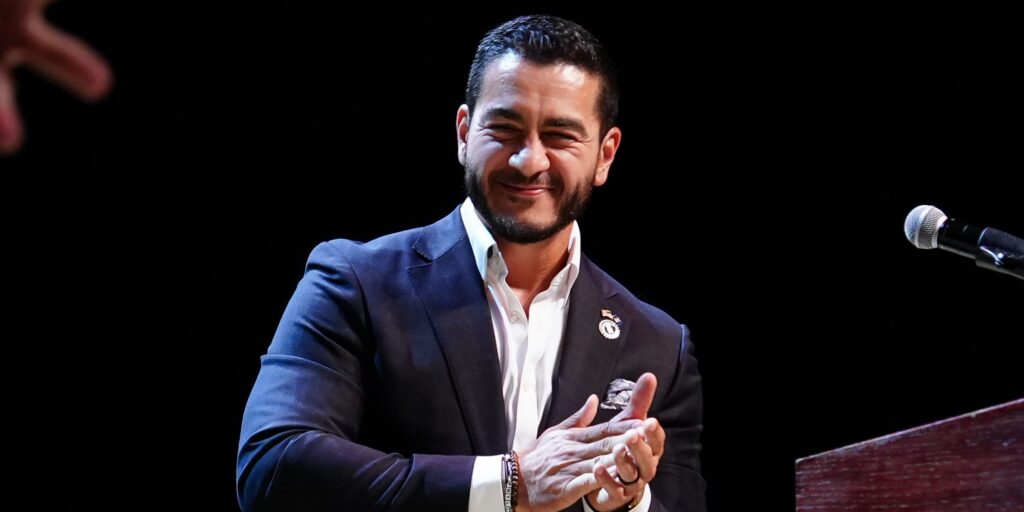
Despite record amounts of outside spending and attacks from the Democratic establishment, Abdul El-Sayed prevailed in a bitter primary race for the U.S. Senate seat in Michigan.
Voters in the key swing state chose El-Sayed over the establishment’s choice of Rep. Haley Stevens, whose campaign received about $60 million in support from pro-corporate and pro-Israel super PACs, making the race the most expensive Democratic primary ever. El-Sayed won by a margin of around 1 percentage point, according to The Associated Press, which called the race in his favor Wednesday morning.
The victory of El-Sayed, a former public health official endorsed by Sen. Bernie Sanders and Rep. Alexandria Ocasio-Cortez, is the latest sign of the growing influence of the Democratic left. And it’s the most staggering illustration yet of the party establishment’s waning grip on power and the unpopularity of the pro-Israel lobby giant, the American Israel Public Affairs Committee, amid shifting American sentiment on Israel and Palestine.
Through its super PAC, the United Democracy Project, AIPAC broke its own single-race spending record by funding $30 million in attack ads against El-Sayed. Ads that dominated airwaves, flooded streaming services, and stuffed mailboxes in the final month of the race misrepresented El-Sayed’s previous comments about Michelle Obama and Michigan Gov. Gretchen Whitmer to allege misogyny, and attempted to paint El-Sayed as a terrorist sympathizer.
El-Sayed’s platform, boosted by an army of 12,000 door-knocking volunteers, centered on policies such as Medicare for All policy, addressing cost of living issues in the state, and removing corporate spending from politics. But it was the two candidates’ stances on Israel and Palestine that came to define the race. El-Sayed condemned Israel’s genocide of Palestinians in Gaza and committed to ending U.S. military aid to Israel. His criticism of Israel also extended to its joint U.S. war on Iran, which he decried as military glut that could be spent instead on healthcare and education in his state.
Stevens opposed any conditioning of military aid to Israel. She has consistently voted in favor of weapons transfers since first assuming office in 2019, including last month when she sided with Republicans against an amendment in a Pentagon budget bill that would have cut military spending for Israel. When AIPAC began pouring money into the Stevens campaign, El-Sayed effectively turned those millions of dollars into a key campaign issue, pointing to Stevens as an illustration of the danger of lobby spending and corporate money in politics.
It’s not the first race in Michigan shaped by AIPAC money. Former Rep. Andy Levin — who was considered the most progressive Jewish member of the House because of his support for Palestinian statehood — lost his seat after redistricting forced a showdown with Stevens in 2022. In that race, Levin was also dramatically outspent by outside money, with AIPAC buying $4 million in ads to attack him and boost Stevens.
El-Sayed’s success, however, shows a major shift in politics since the start of Israel’s most recent war on Gaza. Cutting off military support to Israel has become a mainstream position among Democrats. And AIPAC has since become a politically toxic entity — “a four letter word in Democratic politics,” Levin told The Intercept.
“The kind of truth-telling about Israel and Palestine is tied into the truth-telling about the economy, and people wanting real solutions.”
“Most people still don’t vote on Israel and Palestine, they vote on their pocketbooks,” said Levin, who endorsed El-Sayed. “But if you’re not willing to say that Israel perpetrated a genocide in Gaza, Democratic primary voters are like, ‘OK, you’re bought and paid.’ The kind of truth-telling about Israel and Palestine is tied into the truth-telling about the economy, and people wanting real solutions.”
Leftists have claimed victories against establishment picks throughout this year’s midterm primaries, running on similar platforms addressing affordability and support for Palestine. But those wins have so far been in House races, mostly in metropolitan areas where leftist progressive politics have gained a foothold in recent years, such as New York, Pennsylvania, Colorado, New Jersey, and California. In House races in Michigan, leftists also found success with wins for Donavan McKinney, a state representative who defeated the AIPAC-backed incumbent Democratic Rep. Shri Thanedar, and Will Lawrence, a progressive climate activist who beat a pair of moderate Democratic opponents.
Both McKinney and Lawrence, a co-founder of the youth-led Sunrise Movement, had an endorsement from Sanders and a mutual endorsement from El-Sayed. And both ran on a similar platform of lowering the cost of living and opposing war — including Israel’s genocide in Gaza — and for Lawrence, opposing AI data centers. While McKinney is expected to win the general election in a solid blue district, Lawrence now faces a Republican incumbent, Rep. Tom Barrett, in a purple district that had previously been held by Democratic Sen. Elissa Slotkin.
El-Sayed’s win is the first leftist victory in a Senate race this election cycle.
Unlike other leftist wins so far in the midterms outside of Michigan, El-Sayed faces a difficult challenge in the general election from a formidable Trump-endorsed opponent. Polls have shown El-Sayed neck-and-neck with Republican Mike Rogers, a former congressman and FBI agent who ran unopposed in Tuesday’s primary. In 2024, Rogers ran for Senate and lost to Slotkin by less than 20,000 votes. In Michigan, where voters swung for Trump by about 1 percentage point over Kamala Harris in 2024, the November election is expected to be the most significant midterm test for the left. An El-Sayed win in November is essential to the Democratic effort to regain control of the Senate.
Electability has been among the largest criticisms from Stevens and her supporters against El-Sayed. Conventional establishment thinking maintains that progressive policy is not popular among most Americans. To beat Republicans, the centrists say, Democrats need to run a more moderate candidate who can appeal to more conservative voters. Late last month, the Stevens campaign circulated a quote from Rogers, who called El-Sayed “radical” and claimed “I don’t think he likes America.” Stevens suggested Rogers would prefer to face El-Sayed because of his leftist platform.
To read the full article, go to The Intercept
By Jonah Valdez On Aug 5, 2026
Author Profile

Latest entries
 War09/16/2026“No good options: Trump insiders reveal crisis that ‘thwarted’ the GOP”, Nick Hilden, AlterNet.
 Labor Rights08/24/2026Socialists’ Winning Streak Is an Opportunity for Unions
 Political Elections08/21/2026Abdul El-Sayed Beats the Democratic Establishment and AIPAC in Michigan
 Democratic Socialism08/14/2026No, AOC: “Woke” Wasn’t “Crazy” the Way You Say It Was