Why socialist Cuba is more democratic than the U.S
The renewed escalation of hostility by the Trump administration towards Cuba—through tightened sanctions, political pressure, and open ideological aggression—once again exposes a fundamental contradiction.
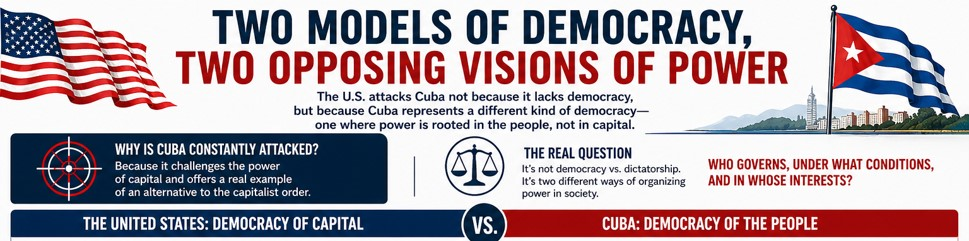
A country that presents itself as the “global model of democracy” continues to treat a small socialist island as a persistent threat. This is not a coincidence. It points to something deeper: what is being contested is not “democracy” in the abstract, but two fundamentally different ways of organizing power in society.
At a moment when Cuba faces intensified economic pressure and systematic attempts at destabilization, a simple question emerges: if Cuba is truly “undemocratic,” why must it be constantly attacked, isolated and discredited? And, just as importantly, what does it reveal about the United States that it invests so much effort in undermining it?
The answer is not complicated. What we are dealing with is not a comparison between democracy and its absence, but between two opposing conceptions of democracy—one grounded in the power of capital, the other in an attempt to organize political life beyond it.
This is where the discussion must begin. Democracy is never just about institutions on paper; it is always rooted in real social relations. The decisive issue is straightforward: who actually governs, under what conditions, and in whose interests?
In the United States, formal political rights exist, but they operate within a society marked by extreme inequality. A relatively small economic elite controls key sectors of the economy—and that influence does not stop there. It extends directly into political decision-making. The well-known study by Gilens and Page made this clear: when the preferences of economic elites diverge from those of the majority, policy outcomes tend to follow the elites.
Put simply: the majority participates, but it does not decide.
The institutional framework only sharpens this reality. The Electoral College allows candidates rejected by the popular vote to take office. The much-praised two-party system narrows political life to two formations that, despite differences in rhetoric, defend the same economic foundations.
This is not genuine choice—it is variation within limits set in advance.
And then there is the decisive factor: money. U.S. federal elections cost around $14 billion in 2020. After the Citizens United ruling, corporations and wealthy individuals gained the ability to spend without meaningful limits.
What this produces, in practice, is straightforward. Political competition becomes a financial competition. Visibility depends on funding. Viability depends on funding. Success depends on funding.
When money determines who can be heard, it also determines who can rule.
This brings us to the most persistent myth used to defend the system—the claim that “everyone is free to make his choices.” Once examined seriously, this argument falls apart.
Free to choose what, exactly—and under what conditions?
For millions in the United States, daily life is shaped by economic insecurity. A large share of the population cannot easily absorb even small unexpected expenses. Under such pressure, the idea of freely choosing between jobs or life paths becomes questionable.
To read the full article, go to In Defense of Communism
By Nikos Mottas on April 3, 2026
Author Profile

Latest entries
 War09/16/2026“No good options: Trump insiders reveal crisis that ‘thwarted’ the GOP”, Nick Hilden, AlterNet.
 Labor Rights08/24/2026Socialists’ Winning Streak Is an Opportunity for Unions
 Political Elections08/21/2026Abdul El-Sayed Beats the Democratic Establishment and AIPAC in Michigan
 Democratic Socialism08/14/2026No, AOC: “Woke” Wasn’t “Crazy” the Way You Say It Was