In “Devastating” Immigration Ruling, Supreme Court Allows Trump Admin to “Turn Back” Asylum Seekers
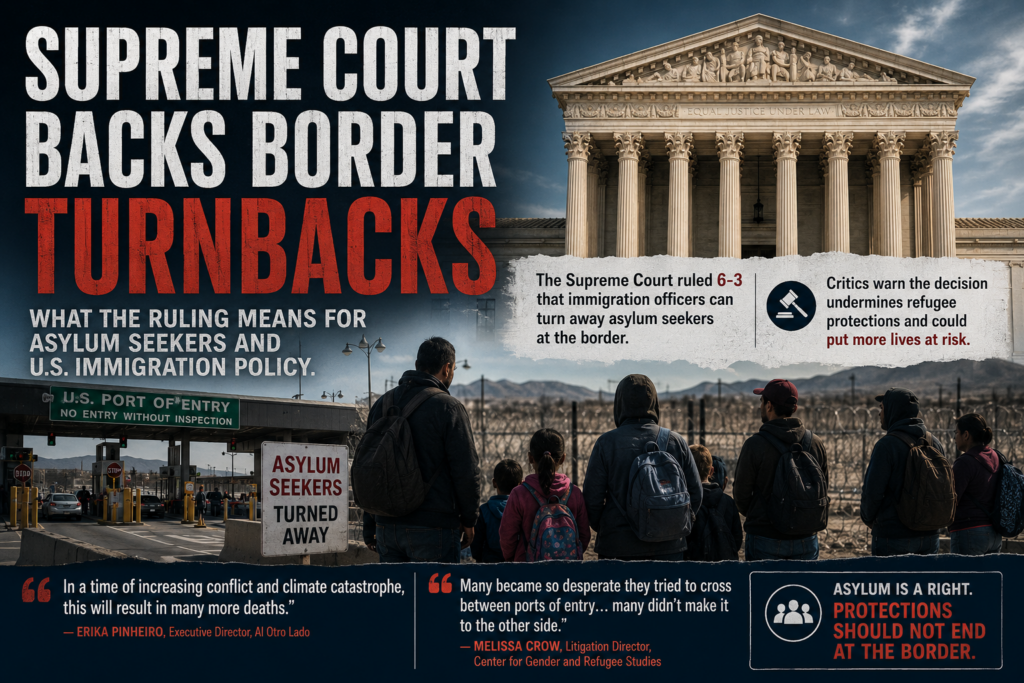
The Supreme Court has sided with the Trump administration in a major blow to the rights of immigrants, refugees and asylum seekers. The court ruled 6 to 3 along partisan lines to sanction so-called metering at the southern border, which allows immigration officers at ports of entry to block asylum seekers from setting foot on U.S. soil.
“In a time of increasing conflict and climate catastrophe, this will result in many more deaths,” warns Erika Pinheiro of Al Otro Lado, the lead plaintiff in the case. When the turnback policy was first introduced, recounts Melissa Crow of the Center for Gender and Refugee Studies, who served as co-counsel for the plaintiffs’ case, many asylum seekers became “so desperate that they ended up trying to enter between ports of entry, either by swimming across the Rio Grande or by traversing the desert under harrowing conditions, and many, many of them didn’t make it to the other side.”
Transcript
This is a rush transcript. Copy may not be in its final form.
AMY GOODMAN: The Supreme Court ruled Thursday in a 6-to-3 decision that the Trump administration can turn back asylum seekers at the border, and that doing so does not violate federal immigration law. The turnback policy, euphemistically called “metering,” allows immigration officers at border crossings to block asylum seekers from setting foot on U.S. soil. The policy is not officially in effect. In fact, it was rescinded in 2021, but the Trump administration asked the Supreme Court to overturn the 2024 appeals court ruling that found the practice unlawful. And the Supreme Court then agreed to hear the case.
The case is Mullin v. Al Otro Lado. Erika Pinheiro is the executive director of Al Otro Lado, the lead plaintiff in the case. She joins us from Mexico City. And Melissa Crowe, litigation director at the Center for Gender and Refugee Studies and co-counsel on the case, is joining us from Maryland.
We welcome you both to Democracy Now! Erika, let’s begin with you. Talk about the significance of the Supreme Court decision, and talk specifically about the case your organization brought, Al Otro Lado.
ERIKA PINHEIRO: So, first of all, thank you so much for having me today.
We originally brought this case because we documented hundreds of asylum seekers being turned away from ports of entry, and also documented many individuals who were assaulted, raped, trafficked or killed because they could not access protection in the United States. This particular case is so important, and I think that the importance was really minimized by the justices.
Justice Alito engaged in a rather tortured textual analysis, really focusing on the word “in” to basically say that if individuals cannot set foot on U.S. soil, that they do not have the right to ask for protection at the U.S. border. So, this was really not about the text of the statute. It was to reach the political goal of ending access to asylum at the U.S.-Mexico border. He uses a few analogies in the decision, but I think the most apt analogy would be if a police officer were standing outside of a polling place, and the Supreme Court decided, even though he’s pointing a gun at you, and you couldn’t go inside the polling place, you still have the right to vote. I mean, it’s just ridiculous. But that, unfortunately, was the decision the Supreme Court.
The practical effect right now is not going to be a huge change, because, like you mentioned, the policy has not been in place since 2021, but the broader effects are really significant. First, it undermines international cooperation around the Refugee Convention. It legitimizes turnbacks for other countries that are engaged in this practice, of which there are many. And it really just solidifies the idea that human beings cannot cross borders to seek safety. And in a time of increasing conflict and climate catastrophe, this will result in many more deaths.
JUAN GONZÁLEZ: And, Erika, can you talk some about how this closure of the border, really, that’s happened, especially in the last few years, has impacted Mexico and people and migrants or refugees arriving in Mexico?
To read the full article, go to DEMOCRACYNOW
By Amy Goodman On Jun 26, 2026
Author Profile