We Are Spending Billions to Bomb Iran. Who Is Actually Paying for This?
I want to start with a number that stopped me cold this morning.
The United Nations Food and Agriculture Organization reported today that between 510 and 520 million people could still be facing hunger by 2030. Not because of a drought. Not because of a natural disaster. Because a war that most of us never voted for, never debated properly in Congress, and are only now beginning to understand the full cost of is already reshaping who gets to eat on this planet.
Let that sit for a second.
Let’s Talk About the Numbers They Don’t Want You to Do the Math On
When the United States launched its war against Iran in February 2026, the Pentagon said it would cost about $11 billion for the first week. Then the real numbers started leaking out. A billion dollars a day. Sometimes two. By May the admitted cost passed $29 billion. By July it officially hit $37.5 billion and internal defense department analysis puts the actual number as high as $80 to $100 billion.
Now Trump is asking Congress for a $1.5 trillion military budget for next year. That is nearly $600 billion more than what was spent before this war began. When you break that down, the average American taxpayer already sends over $4,000 a year to the Pentagon. Under the new budget every household in this country would pay an additional $4,600 on top of that.
So let me ask the obvious question that Washington refuses to answer.
What did we benefit from all this?
Nobody Voted on This. But Everyone Is Paying for It.
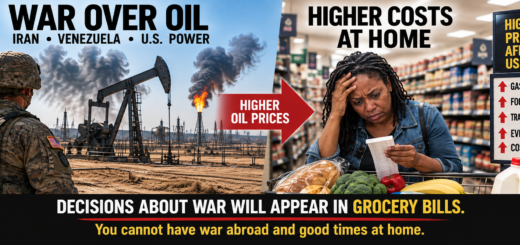
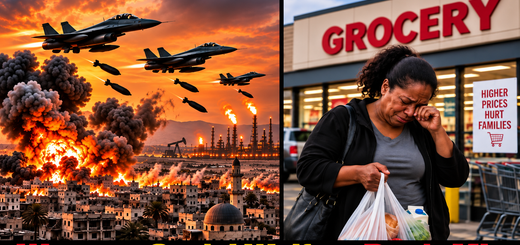
The war does not look like explosions on most people’s screens. It looks like the checkout counter at the grocery store.
Here is how it actually works. Diesel is what moves food. It powers the trucks carrying produce, the ships crossing oceans with grain, the machines harvesting crops. When the Strait of Hormuz, a narrow waterway carrying one fifth of the world’s oil, gets disrupted by war, diesel prices go up. When diesel goes up, fertilizer goes up. When fertilizer goes up, crop yields fall. When crop yields fall, food prices rise. That chain of consequences does not care about borders or politics. It lands on everyone.
Inflation has hit a three year high. Nearly 4.2% annually, almost double what it was before this war started. People with six figure salaries are reportedly taking out loans for groceries.
Families are putting food on high interest credit cards, paying 25% interest, spending $125 to buy $100 worth of food. Some lenders are charging 300%, even 600% interest in certain states. Wages are not keeping up. Layoffs are accelerating. Working people are caught in what economists are calling a financial loop they cannot break out of.
And even the loudest defenders of this war are now saying publicly that people are hurting and sick of it. When the people defending a policy start acknowledging the pain it is causing, you can stop asking whether the pain is real.
The Numbers Behind the Silence
The money spent in just the first months of this war would have fully funded universal childcare for every family in America for years. It would have covered the healthcare gaps forcing rural hospitals to close. It would have extended food assistance programs that are currently being cut at the exact moment grocery prices are rising fastest.
Instead that money is burning over the Strait of Hormuz.
The food bank serving Buffalo and Western New York just opened a new campus because demand has grown beyond what their old facility could handle. Rising costs. More need. Less capacity. That is the Iran war translated into a community that never asked for any of this. And it is happening in cities and towns across the country that never sent a single person to the decision making table where this war was decided.
The casualties are also higher than what is being admitted publicly. The official death toll was quietly lowered, not because fewer soldiers died but because the government changed how it was counting. Gold Star families are speaking out, contradicting the official version of events directly. The people closest to the human cost of this war are the ones being told their loss was worth it by the people farthest from any risk of sharing it.
What Are We Actually Leaving Behind
This is the question I keep coming back to.
We are burning through the world’s most finite energy resources to conduct a war with no defined end date and no clear victory condition. Every barrel of oil used in military operations is a barrel that will not be available to heat a home, power a school, or transport food to a community that needs it. Scientists have spent decades explaining that these resources are not coming back. We are using them now, in explosions, and the next generation will inherit whatever is left.
The FAO’s chief economist warned this week that the war’s effect on food production is not a short term spike. Higher fertilizer costs reduce yields. Lower yields mean less food. Less
food means higher prices, not just this year but next year and the year after. The 500 million people projected to still face hunger in 2030 are not statistics. They are people who will grow up in a world where decisions made in 2026 made it harder to feed everyone.
And inflation does not stop when a ceasefire is signed. Even if the war ended today the economic damage will be felt for years. Energy infrastructure takes time to rebuild. Supply chains take time to stabilize. Agricultural consequences play out over multiple growing seasons. One economist put it plainly: the inflation genie is out of the bottle. You cannot put it back just by stopping the bombs.
Is This Development? Is This a Future?
I am a student. I am not an economist or a military strategist. But I can read and I can add, and what I am reading and adding does not make sense to me.
We are spending one to two billion dollars a day on a war that most people did not want. We are burning through energy resources that cannot be replaced. We are driving up food prices at a moment when hundreds of millions of people are already hungry. We are cutting healthcare, gutting food assistance, closing hospitals and schools and sending that money to the Pentagon instead.
And the people making these decisions are telling us the economy is booming.
Who is that boom for? Because from where I am sitting it does not feel like a boom. It feels like a transfer. Money moving from the people who need it most to the systems that need it least. The total cost of maintaining the American military empire now exceeds $2.2 trillion every single year. That is $2.2 trillion not going to clean energy, not going to climate infrastructure, not going to the food systems that will need to feed a growing world on a warming planet.
We are not building anything with this war. We are not developing anything. We are not leaving anything behind for the people who come after us except debt, depleted resources, and the long tail of economic damage that nobody at the top will be around to answer for.
So Let Me Ask You Directly
Is this worth it?
Is $37.5 billion headed toward a war which gives no benefit for humanity worth it? Is bombing a country for 13 consecutive nights worth 500 million people facing hunger? Is the financial pressure crushing working families across this country and around the world worth a military budget that now consumes more than education and healthcare combined?
What are we leaving for the generation that comes after this one?
Not energy. We are burning it now. Not food security. We are actively threatening it. Not financial stability. We are dismantling it week by week. Not peace. We are nowhere close.
The truth is not complicated. It is just inconvenient for the people who profit from the war and will not be around to live with its consequences. The families watching prices rise every week, the farmers absorbing costs they cannot control, the communities lining up at food banks already beyond capacity, the children who will inherit whatever is left of the energy and food systems we are choosing right now to treat as expendable — we are the ones living with these consequences.
And it is past time we said so out loud.
Author Profile