The Housing Act Trades Affordability for Builder Profits
Op-ed: The ROAD to Housing Act – which just became law without Trump’s signature – won’t deliver real affordability because it rests on two faulty economic assumptions.
Congress just passed the largest housing bill in decades with votes from every Democrat, and almost every Republican. Trump, in his latest tantrum, denied them the fanfare of a signing ceremony, but the law is a big deal. The 21st Century ROAD to Housing Act will clear out old regulatory gunk, speed up permitting, and lower building costs.
The Bipartisan Policy Center found that nearly 90% percent of voters wanted Congress to make housing more affordable. But sadly, this law won’t do that — because new homes aren’t necessarily affordable homes. Congress overlooked that fact because they were relying on two faulty economic assumptions: they took a narrow view of supply and demand, and they recycled a piece of Reagan-era propaganda.
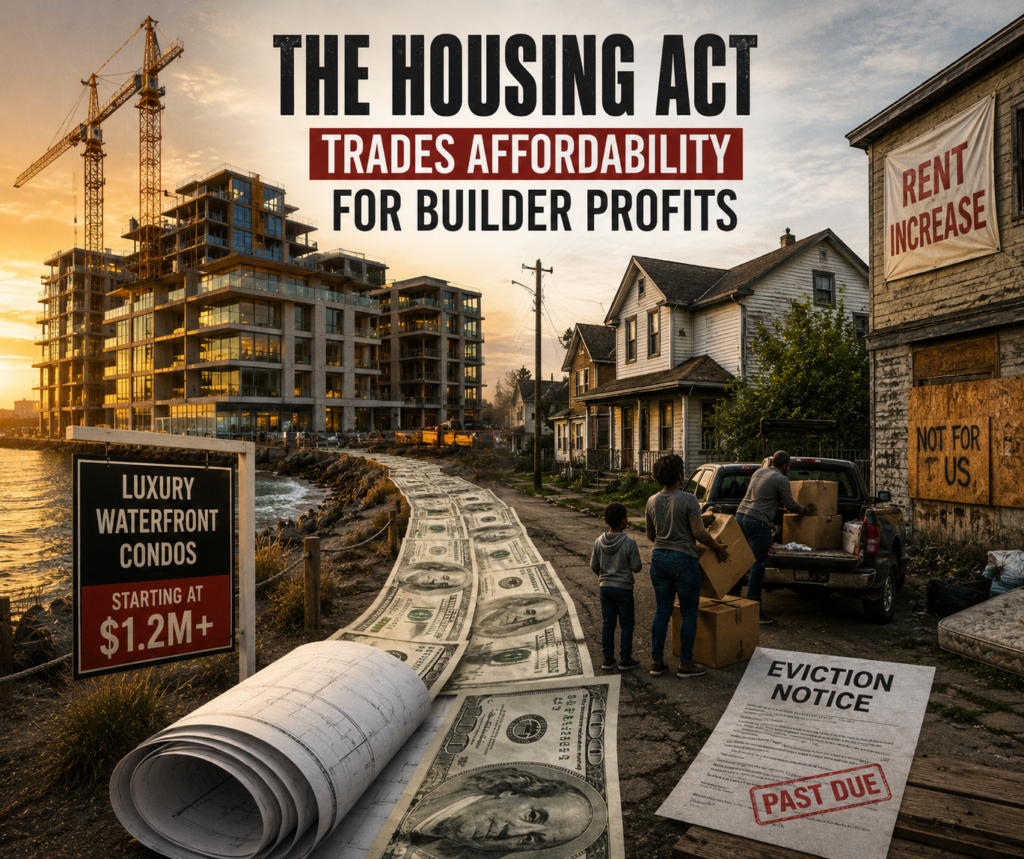
Congress’s first bad assumption was that supply alone will save us, viewing the housing situation like a graph in a textbook: if you increase supply, prices will fall. In theory it’s correct, but it has a huge blind spot: the endless demand coming from high-earners and the whole world’s ultra-wealthy. When every corporate executive wants a third vacation home, and every foreign oligarch wants a pied-a-terre, developers will create new supply to meet their needs and budgets. This is why you see duplexes and penthouses in every new building that goes up. The developers don’t care about affordability. They build for profitability.
And when private companies do decide to serve small budgets, they tend to exploit them. Dollar stores take advantage of food deserts. Payday loan apps like Chime and EarnIn sell cash-strapped people their own paycheck a few days early. Rent-to-own stores sneakily charge three times retail, targeting people who need to budget week-by-week. Often, businesses at the bottom of the market just monetize desperation.
Despite a lot of political theater, this law preserves that opportunity for private equity firms too. Politicians applauded themselves for a section that stops big investors from flipping single-family homes into rentals. But they also wrote an exemption for the same investors to build new single-family rentals. So the stage is set for lots of new housing stock to be owned by investor groups rather than the people living in it.
New supply is absolutely necessary to make housing more affordable. But we need the right kind of supply.
The second bad assumption underpinning this law is a reanimation of Reagan’s trickle-down economics, coming to life in two different forms.
Form #1 is trickle-down houses. Here’s the claim: developers build expensive units, and over time, those units age, depreciate, and filter down to people with lower budgets. It’s like arguing that Michelin-star restaurants are helping with the hunger crisis because there will be free food in their dumpsters. It’s also demonstrably false. Buildings don’t filter down. They get renovated and resold. In fact, many building owners can flip units so profitably that they’ll pay low-income tenants hundreds of thousands of dollars to vacate.
Form #2 is trickle-down construction savings. Deregulation will decrease building costs, and (mostly Republican) politicians claim the savings will reach ordinary people. This Reaganism has been quietly tormenting us for forty years, and corporate interests are using it to shroud their core motivations here. Firms always keep cost savings as profit for as long as they can, and they often collude to maintain those margins indefinitely. Cheaper to build does not mean cheaper to buy.
Republican Senator Rick Scott quipped, “point me to the section of the bill that actually makes housing more affordable for middle class families,” and he’s right. That’s not in this law. But it is in three bills introduced in 2024: the Green New Deal for Public Housing Act, the Homes Act, and the PASHNY Act in New York. The Green New Deal for Public Housing Act would fund long-needed renovations to the public, guaranteed-affordable housing that already exists. The Homes Act would create new housing that’s guaranteed, by law, to be permanently affordable. PASHNY would do both, specifically in New York State.
These bills are on the docket, and the model of mixed-income, sustainably-financed, permanently affordable housing is gaining momentum. Seattle just approved a similar initiative, and a broad coalition in New York is revving up. Stay tuned. We might get to see what happens when the new supply is designed, built, and designated for people instead of profit.
To read the full article, go to nextcity.org
By Evan Hunerberg On July 13, 2026
Author Profile

Latest entries
 War09/16/2026“No good options: Trump insiders reveal crisis that ‘thwarted’ the GOP”, Nick Hilden, AlterNet.
 Labor Rights08/24/2026Socialists’ Winning Streak Is an Opportunity for Unions
 Political Elections08/21/2026Abdul El-Sayed Beats the Democratic Establishment and AIPAC in Michigan
 Democratic Socialism08/14/2026No, AOC: “Woke” Wasn’t “Crazy” the Way You Say It Was