Project that aims to transform Broadway-Fillmore gets $3M boost from Mother Cabrini
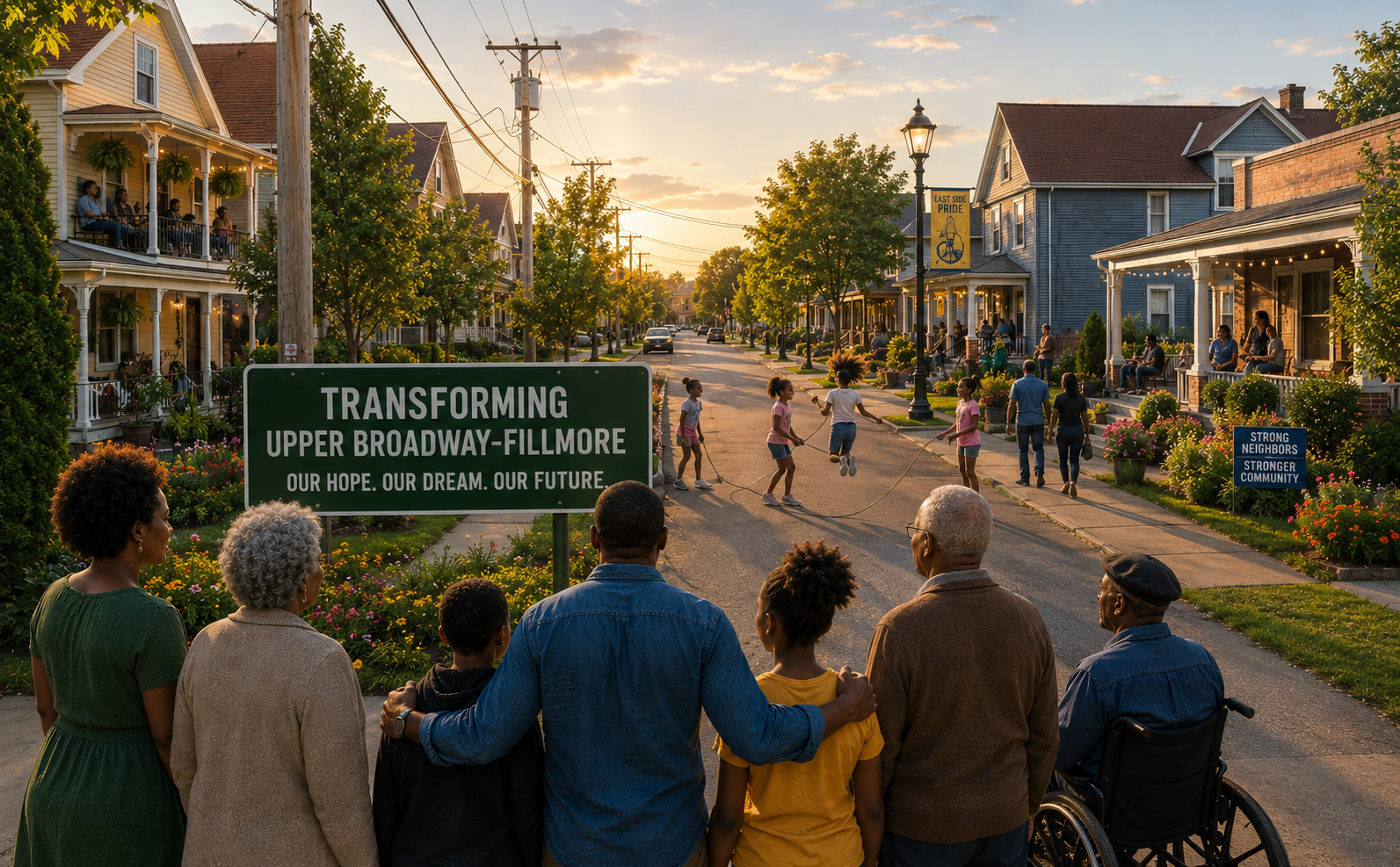
The Upper Broadway-Fillmore Neighborhood Transformation Project
Henry-Louis Taylor, Jr.
Press Conference — Announcing the $3 Million Mother Cabrini Health Foundation Grant
11 June 2026
The purpose of the East Side Neighborhood Transformation Project is to improve health outcomes and increase the life chances of East Side residents by transforming their neighborhoods into healthy, thriving, and joyful communities. However, because the East Side is such a large, diverse, and complex community, we begin the initiative by launching a demonstration project in a single neighborhood where we can develop, test, and refine our model for transforming underdeveloped neighborhoods into great places to live. Once perfected, the model will be applied to other East Side neighborhoods. We understand that neighborhood transformation cannot be sustained without changing the metropolitan city building process and building a just metropolis. This project is a beginning, not an end.
We have selected the Upper Broadway–Fillmore neighborhood (Census Tract 166) as the site for this demonstration project. Transforming Upper Broadway-Fillmore into a healthy, thriving, and joyful community will be difficult. Black Buffalo has lived in the most undesirable neighborhoods and in the most inadequate housing since the city was founded. And for most folks, it is easier to imagine the end of the world than it is to imagine ordinary Blacks living in wonderful communities. This inability to imagine a vibrant, prosperous Black community is, in itself, an obstacle to the community’s transformation. We aim to change this reality.
We have developed a new model of neighborhood transformation designed to turn Upper Broadway-Fillmore into a great place to live for its current residents. This model places people’s needs, wants, and aspirations over profit-making and wealth accumulation. It aims to build a healthy, nurturing neighborhood where residents can reach their full potential, in a community where ordinary people will have access to the best that humanity and technology have to offer.
This people-centered model dares residents to dream and empowers them to drive the neighborhood transformation process. At the outset of this initiative, for example, we will launch a future neighborhood visioning and planning process, which will involve roughly 80% of the community’s residents. The purpose is twofold.
Our first step is to build unity around the type of neighborhood the residents seek to build. There is an old African proverb that says that a person without a target cannot miss, but neither can they hit anything. This vision of the future neighborhood — that we aim to build — gives us a target — a destination that this neighborhood intends to reach.
Our second step is to use the neighborhood planning process to build a pathway to that destination by generating the projects, programs, and activities that the neighborhood must implement to reach its future self. Collectively, this visioning and neighborhood planning process is grounded in the principle of fusing resident knowledge and wisdom with expert knowledge and wisdom to create a synergistic relationship that provides the project with the skills and capacity to effect change.
At the same time, the neighborhood transformation project will not wait until the visioning and planning processes are completed before taking action. This initiative will implement projects while residents simultaneously imagine, design, and plan the future neighborhood. As these activities unfold, we will be fixing the houses where people live, building new housing units, and engaging in activities designed to help families navigate and negotiate their environment. We will also be developing a job-training program that enables residents to participate directly in the development of their community — rebuilding their lives as they rebuild their neighborhood.
One of the most critical and difficult dimensions of this people-centered model is the struggle to gain ownership and control of the land where residents are building their community. This objective will require completing two interactive tasks. The first is to use a community land trust to acquire shared ownership of community land and resources, while the second involves fundamentally changing the relationship between the Upper Broadway-Fillmore neighborhood and the metropolitan city builders — government and the financial, real estate, development, and property management industries.
We seek to establish a collaborative relationship in which these entities suppress their profit-making and wealth-accumulation urges and find innovative ways to create shared value with the Upper Broadway-Fillmore neighborhood. Following the Harvard economist Michael Porter, we want the private sector to learn how to create economic value and profits while simultaneously creating social value by addressing the needs and challenges facing this community in a non-wealth-extractive, supportive manner.
Furthermore, we want the government to partner with us under community leadership — thereby refining the definition and operationalizing the concept of public servant. If the people best understand the challenges they face, then the government should be willing to follow their lead in the neighborhood development and transformation process. Thus, in the people-centered model, government and the private sector should contribute to neighborhood transformation by entering the Upper Broadway-Fillmore neighborhood and collaborating with the community to test bold new ideas and approaches to neighborhood transformation.
Operating within this context, the Upper Broadway-Fillmore Neighborhood Transformation project is guided by a set of core principles: unity, community control of neighborhood development, shared ownership of land and community resources, cooperative housing, a solidarity neighborhood economy, neighborly reciprocity, a culture of health, and community wealth-building.
The aim is to build a community that enables people to become the best they can be, that leaves no one behind, that controls its own destiny, and that is anchored by the principle of collective work and responsibility. This vision is our hope. Our dream. Our Future.
Author Profile

Latest entries
 War10/15/2026
 Political Elections10/08/2026“GOP is already deep in the stages of grief as midterm losses loom”, Emily Singer, Daily Kos.
 War09/16/2026“No good options: Trump insiders reveal crisis that ‘thwarted’ the GOP”, Nick Hilden, AlterNet.
 Labor Rights08/24/2026Socialists’ Winning Streak Is an Opportunity for Unions