The Socialist Electoral Project Still Hasn’t Hit Its Ceiling
Francesca Hong’s defeat was a setback for the Left. But lost in discussions of the campaign’s shortcomings is how much she actually accomplished. Hong may have opened the door to a new era of politics for Wisconsin and the Left more broadly.
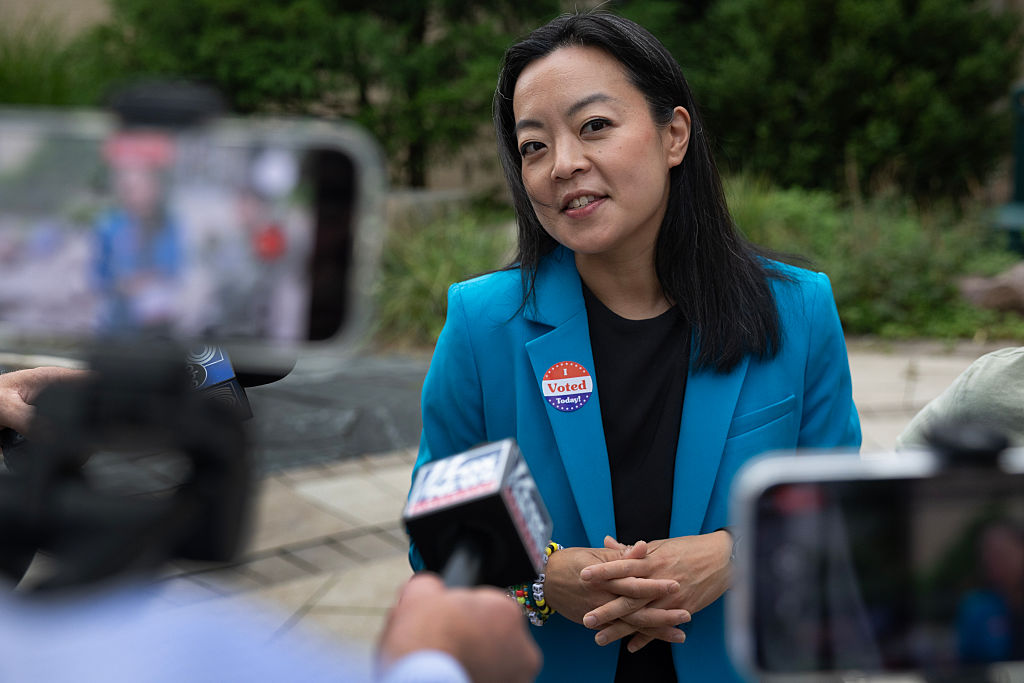
Last night was a sobering one for the Left. After months of exhilarating victories, including Abdul El-Sayed’s stunning Michigan Senate primary win just last week, the Left’s hopes for another high-profile Midwest triumph crashed in Wisconsin, where socialist gubernatorial candidate Francesca Hong saw her double-digit polling lead evaporate into a 0.5-point defeat to the Democratic establishment’s centrist choice, David Crowley.
That result is already being used to create the impression that this was a wholesale rejection of socialists up and down the ballot, which is not the case. Five of eight candidates endorsed by Democratic Socialists of America (DSA) chapters in Wisconsin and Minnesota won their races last night, while four more advanced to the general with no challenger, and a further five of seven DSA-backed candidates are moving on to the general election in Connecticut and Vermont. And one of those losing DSA-backed candidates lost to another, non-DSA-endorsed socialist.
But there is no doubt Hong’s race was by far the most coveted prize for the Left last night and the most important electoral test for socialists in particular, given it was a statewide race in the Midwest and that unlike the victorious El-Sayed in Michigan, Hong actually identifies as a socialist. What explains such a bitter, if narrow, defeat only one week after the broad Left was riding high in a neighboring state?
Was it the money? If Michigan proved that big money can be overcome, Wisconsin is a reminder that it still often wins out. Pro-Hong forces were massively outspent, their less than half a million dollars on ad spending dwarfed by the $4 million spent by the pro-Crowley camp, a significant chunk of which went toward an attack ad in the home stretch casting Hong as a risky candidate in the general election. Weeks before the election, 45 percent of voters were undecided, and there is ample anecdotal evidence that they were swayed by messaging that cast doubt on Hong’s ability to appeal to a wider electorate in the general.
“Fear won out last night, by a narrow margin,” says socialist State Assembly Member Ryan Clancy, who also won reelection last night to his third term. “It was the idea from the beginning, to make a campaign based on character assassination and focused on the specter of electability, instead of on what Wisconsin needs after a decade of Republican control.”
Was it the campaign’s own unforced errors? Hong didn’t go negative against her opponents, even as they turned to attacking her and fearmongering about her old tweets. She was also the only candidate to not spend a single dollar on traditional TV and focus instead on streaming services and other digital ads, a deliberate strategy her campaign spokesperson boasted about on the eve of the election. Hong herself seemed to recognize that mistakes had been made, reportedly planning to replace campaign staff with more experienced operatives if she had won the race.
Was it Hong’s own vulnerabilities as a candidate? Hong was hammered in the final weeks over old “woke” tweets expressing support for abolishing the police, calling to “cancel Thanksgiving” and other beloved holidays, and discussing race in alienating ways that reflected the prevailing progressive style of the era but that have aged poorly now — particularly on public safety, as some socialists are beginning to argue for a “carceral minimalism” framework rather than “abolishing” prison or police. Hong attempted to do as other socialist candidates like New York City Mayor Zohran Mamdani have done and parry these and other attacks by making explicit that she was charting a new course on criminal justice and public safety. But she was not as successful in persuading skeptical voters on it.
Was it the reluctance of leading socialist figures like Bernie Sanders and Alexandria Ocasio-Cortez to lend their endorsement to Hong? They and a parade of other high-profile socialist candidates who had a week earlier rallied with El-Sayed declined to show up for Hong, reportedly because of private doubts about her effectiveness as a candidate. Opinion in the cold light of day is split between whether this could have moved the needle just enough to get Hong the few thousand more votes she needed, or whether Hong’s defeat showed socialist officials were right to stay away. This will likely be a matter of intense debate for some time.
Whatever the case, the months ahead should be a period of self-reflection for the Left if it wants to build off Hong’s surprisingly strong campaign and take advantage of an appetite that clearly exists among the state’s Democratic electorate for a robust left-wing politics.
Hong’s defeat won’t be the only disappointment in Wisconsin that socialists will have to reflect on. Former Catholic priest David Liners, who had been endorsed by Hong, Clancy, and Wisconsin Electoral Socialists — an organization founded two years ago to support socialist candidates for public office — fell short last night in his state assembly bid.
So did the DSA-endorsed socialist running for Hong’s state assembly seat, Juliana Bennett. But while this might be a setback for perceptions of the power of DSA’s ground game, it is not necessarily one for the movement as a whole: the candidate who beat her, Madison Common Council Member Dina Nina Martinez-Rutherford, is also a socialist and will become the first openly transgender person to serve in Wisconsin’s state legislature if she wins in the general.
Meanwhile, in the primary to see who would try to flip the purple Third Congressional District, former Eau Claire City Council President Emily Berge — not a socialist but endorsed by the local DSA chapter — lost to her more centrist opponent, Rebecca Cooke, in another race that shows that Sanders and the movement he inspired don’t always overlap. Sanders had chosen Cooke, a former Democratic fundraiser who now works as a restaurant server, as his only Wisconsin endorsee this cycle, even though she dragged her feet on backing a data center moratorium and has waffled on Medicare for All.
This string of losses in Wisconsin will be a bitter pill to swallow for socialists in and beyond the state. But it should also be kept in perspective. For one, Clancy tells me that the Wisconsin Legislative Socialist Caucus is set to expand from its current four members in the next legislative session, even with the loss of Hong who joined two years ago, though he can’t disclose specific names of new members just yet.The fact that Hong, a three-term socialist state assembly member, even got as far as she did is a fairly remarkable development for the Left.
Looking more broadly, the fact that Hong, a three-term socialist state assembly member, even got as far as she did is a fairly remarkable development for the Left. The socialist caucus in Wisconsin’s legislature did not even exist four years ago, and the last time one did was nearly ninety years before that. This result means that in the space of a few years, socialists have gone from having no representation in the state legislature, to just two assembly members, to coming within less than half a percentage point of taking the Democratic nomination for governor. While the Hong defeat is a setback in the short term, from a wider lens, her campaign is the product of rapid socialist growth that no centrist Democrat in the state will be looking at with carefree eyes.
To read the full article, go to Jacobin
By Branko Marcetic On Aug 12, 2026
Author Profile

Latest entries
 War10/15/2026
 Political Elections10/08/2026“GOP is already deep in the stages of grief as midterm losses loom”, Emily Singer, Daily Kos.
 War09/16/2026“No good options: Trump insiders reveal crisis that ‘thwarted’ the GOP”, Nick Hilden, AlterNet.
 Labor Rights08/24/2026Socialists’ Winning Streak Is an Opportunity for Unions